Cables, battery interconnection and protection must be confirmed by an engineer, so they are not included in the price.
The upper limit is 16 LB-16D-G3 batteries in parallel (up to 256 kWh, per Hoymiles). An engineer will confirm how many batteries the inverter power and your load need.
One LB-16D-G3 delivers 157 A continuously and the HIS-6L-G3S draws up to 135 A from the battery, so the full 6 kW is available from a single battery.
Compatibility per Hoymiles data: HIS-G3 REV1.7 / HIT-5-20L-G3 V1.0 datasheets (battery 40–60 V, CAN communication) and LB-16D-G3 REV1.6.
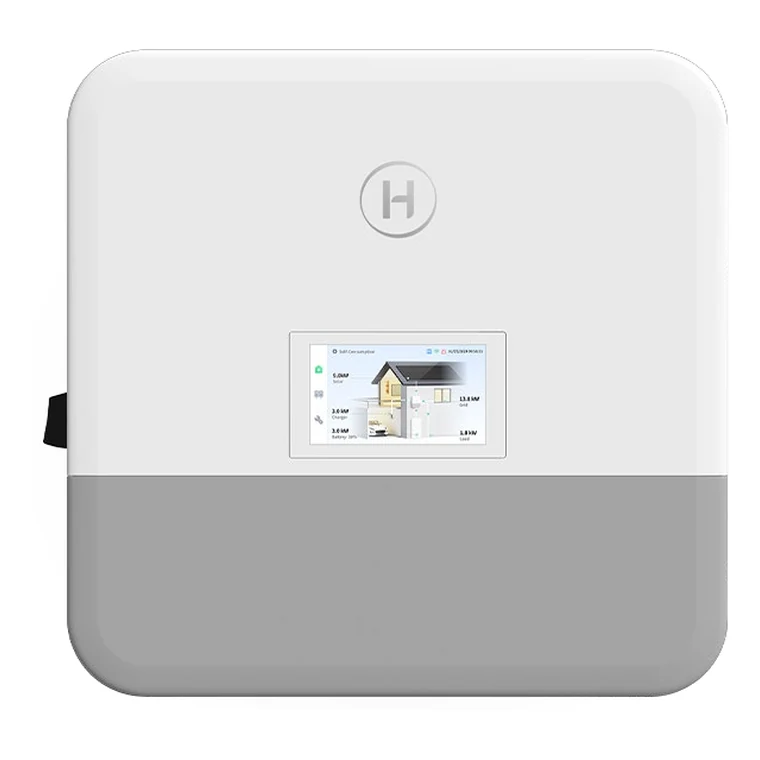
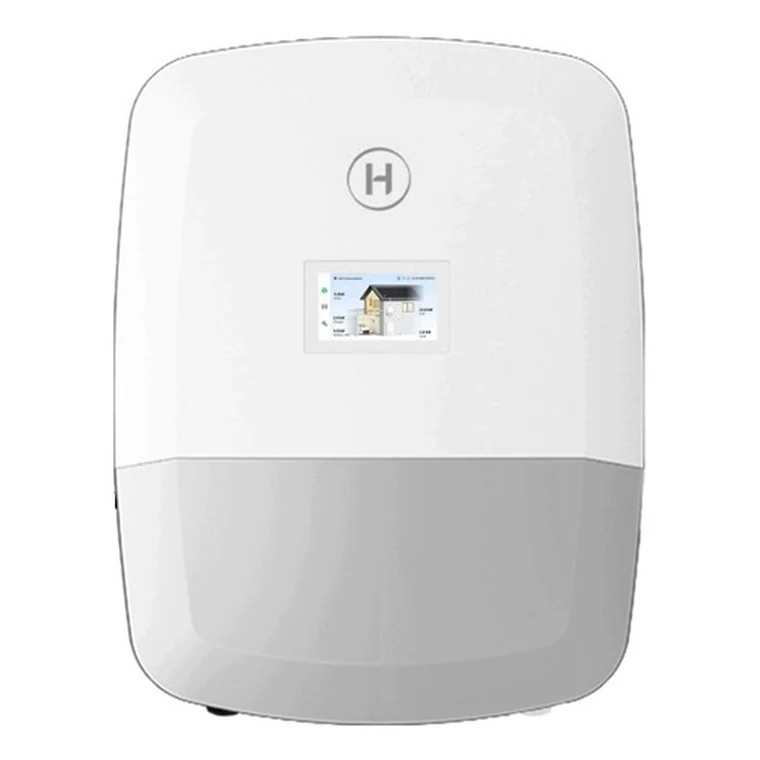
Hoymiles HIS-6L-G3S is a 6 kW single-phase hybrid inverter for the grid, solar panels and 48 V low-voltage batteries (40–60 V range). Battery charge and discharge current is up to 135 A and discharge power up to 6.3 kW, so the inverter's full power can be drawn from the battery. The G3S version has a colour LCD screen; it can also be controlled via an app.
It accepts up to 12 kW of solar panels on 2 MPPT trackers (up to 18 A each). The back-up output delivers 6 kW continuously and up to 12 kVA for 10 s, enough headroom to start a pump or compressor; the manufacturer states a 0 ms switchover to back-up. The IP66 housing is 99 mm thick and weighs 17 kg, operating temperature -25…+65 °C. It supports a generator, heat pump and smart loads, time-of-use schedules and peak shaving, and up to 10 inverters in parallel.
Features
Solar panels up to 12 kW, 2 MPPTs
Battery 40–60 V, current up to 135 A
Peak power 12 kVA (10 s)
0 ms back-up switchover (manufacturer data)
LCD screen and app
IP66, -25…+65 °C
Generator, heat pump, smart load
Up to 10 inverters in parallel
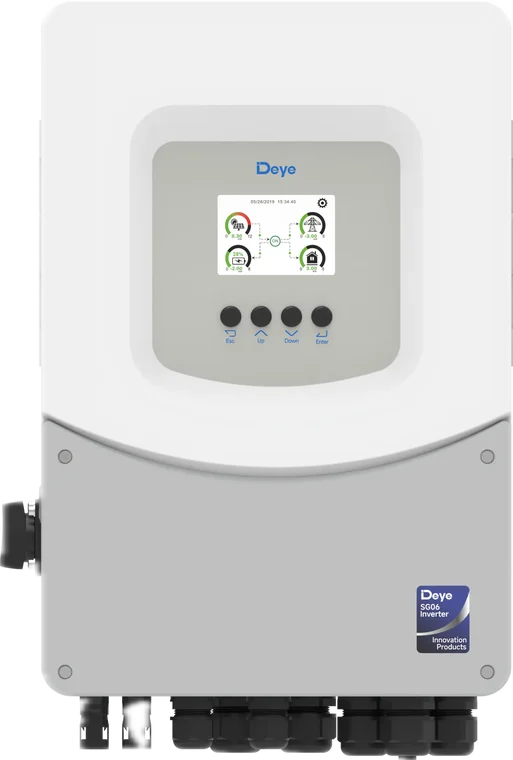
Hoymiles HIS-6L-G3S vs Deye SUN-6K-SG06LP1-EU-BM2: comparison
A comparison with the Deye inverter of the same power, which is also in our catalogue. The better value is shown in bold.
Hoymiles HIS-6L-G3S vs Deye SUN-6K-SG06LP1-EU-BM2: comparison
Parameter
Hoymiles HIS-6L-G3S
Deye SUN-6K-SG06LP1-EU-BM2
Rated power
6 kW
6 kW
Back-up output peak power
12 kVA, 10 s
2× rated (12 kW), 10 s
Number of MPPTs
2 (up to 18 A each)
2 (up to 18 A each)
Solar panels
up to 12 kW
up to 12 kW
Max. PV voltage
550 V
500 V
MPPT range
90–500 V
150–425 V
Battery voltage
40–60 V
40–60 V
Max. battery charge / discharge current
135 A
135 A
Pass-through current (grid → load)
50 A
50 A
Max. efficiency
97.7 %
97.6 %
European efficiency
97.0 %
96.5 %
Protection rating
IP66
IP65
Operating temperature
−25…+65 °C
−40…+60 °C
Dimensions (W × H × D)
506 × 495 × 99 mm
310 × 460 × 218 mm
Weight
17 kg
15.6 kg
What this means in practice
MPPT range 90–500 V vs 150–425 V: the inverter starts harvesting earlier in the morning and in cloudy weather, and strings can be longer (PV up to 550 V).
G98, G99, G100, EN 50549-1/-10, CEI 0-21, IEC 62116, IEC 61727, IEC 60068, IEC 61683
Safety / EMC
IEC 62109-1/-2, EN 61000-6-1/-2/-3/-4
Hoymiles manufacturer data (HIS-G3 Series datasheet, REV1.7). The G3S series is the version with an LCD screen. A manager will confirm the compatibility of a specific battery and the warranty terms before you order.
Which batteries are compatible with this inverter?
48 V low-voltage batteries (40–60 V range): lithium-ion with a BMS that communicates with the inverter over CAN, or lead-acid. The matching Hoymiles battery is the 16 kWh LB-16D-G3. We check the compatibility of other battery models before you order.
Can solar panels be connected later?
Yes. The inverter can run with just the grid and a battery, and up to 12 kW of panels on 2 MPPTs can be added later.
How many hours will the system run during a power outage?
It depends on battery capacity and average load. Use the autonomy calculator or send a request and we will calculate it for your list of appliances.
How do I get a price?
Send a request or call us: we'll give you the equipment price together with the installation estimate. Cables, switchgear and protection are selected after a site survey or from a photo of your distribution board.
[→] — Request
Tell us about your property
We will select the configuration, check compatibility and calculate the cost with installation.
Photos of the distribution board, a list of appliances or a roof plan are easier to send by e-mail. Planning an installation? Fill in the technical brief — for a home or a business.