Charge in cheap hoursAt night or at midday, when the day-ahead market has surplus generation, the system charges from the grid.
Supply at peakIn expensive hours the site uses energy from the battery instead of the grid.
EMS automationThe system decides when to charge and discharge and skips unprofitable cycles.
Backup power
Downtime losses are a separate line and only if you enter them.
Peak shaving
Without a per-kW charge we show the technical result only, no money.
Scenario with a solar plant
Generation — PVGIS (European Commission) for the regional center, panels facing south, 35° tilt. CO₂ — environmental value of renewable electricity for 2026 (Ministry of Energy of Ukraine, 1,311 kg/MWh).
Technical and financial assumptions
Upload hourly consumption for a month or a year — the calculator finds the most profitable charge and discharge hours for each day within capacity, power and reserve limits.
Format: CSV or Excel. Columns: date; hour (1–24 or 0–23); consumption, kWh; price, UAH/kWh (optional). Prices in UAH/MWh are converted automatically. Download CSV template
Optimisation uses dynamic programming over a state-of-charge grid (1/60 of usable capacity): one action per hour — charge, discharge or idle; each day starts and ends at the minimum state of charge. This is the potential saving with perfect day-ahead price knowledge.
Results
Savings per day—
Savings per month—
Net savings per year—
Payback—
Energy shifted between periods—
Charging cost—
Avoided peak-hour cost—
Battery degradation—
Operating costs—
Net annual savings—
Autonomy of the critical load—
Avoided downtime losses—
Peak reduction—
Demand charge savings—
Solar generation—
Solar savings—
CO₂ emissions avoided—
Total incl. backup, peaks and solar—
Payback with all benefits—
This is a preliminary estimate. An exact calculation requires hourly consumption data and the terms of your electricity supply contract.
Energy bought per cycle: E_charge = min(capacity × (DoD − reserve) / √efficiency; power × cheap hours; power × expensive hours / efficiency; load × expensive hours / efficiency).
Energy delivered to the site: E_delivered = E_charge × efficiency. Charging cost = E_charge × cheap price; avoided cost = E_delivered × expensive price. Variable tariff components are added to both prices.
Savings per cycle = avoided cost − charging cost − degradation. If negative, the EMS skips the cycle and savings are zero; we show why.
Net annual savings = daily savings × operating days − operating costs. Payback uses net savings; discounted payback also accounts for the discount rate, tariff growth and capacity fade.
Backup, peak shaving and solar are separate lines. They are added to the total only when you enter their value.
[03] — Questions
BESS FAQ
What is a BESS?
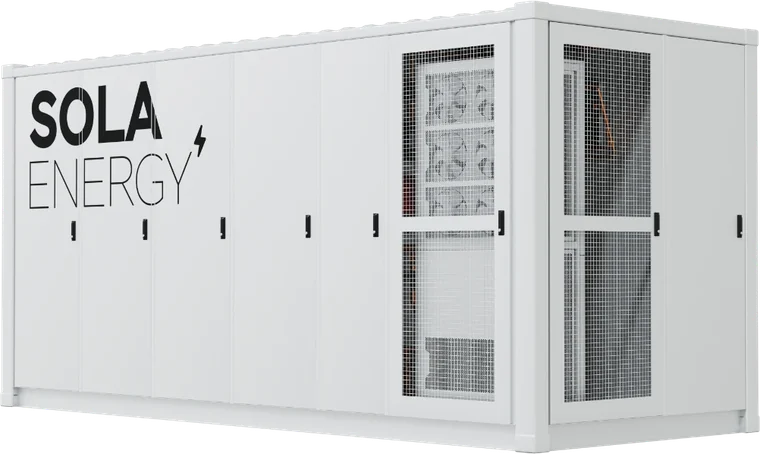
A BESS (Battery Energy Storage System) is an industrial energy storage system: batteries, a power conversion system (PCS) and an energy management system (EMS). It charges from the grid or solar and supplies the site when it pays off or when the grid fails.
How does storing night-time electricity work?
The system charges when prices are low and supplies the site in expensive hours. The saving is the price spread minus round-trip losses. It exists only if the company buys electricity at hourly prices or a time-of-use tariff.
Do I need solar panels for a BESS?
No. The system works from the grid, charging in cheap hours. Solar can be added so the battery also stores your own generation.
How much can I save?
It depends on the price spread, capacity, power and load profile. The quick estimate gives the order of magnitude; the hourly calculation shows the potential on your real data.
What is the payback period of an industrial BESS?
The calculator derives it from the net annual savings and the cost you enter. Payback depends heavily on the price spread and on whether outage backup is valued.
Can a BESS provide backup power?
Yes. Part of the capacity is reserved for emergencies; during an outage the system switches to island mode and powers critical lines. Reserved capacity is excluded from arbitrage — the calculator accounts for this.
What is the difference between kW and kWh?
kW is power: how much equipment the system can supply at once. kWh is capacity: how much energy it stores. A 200 kW / 400 kWh system delivers 200 kW for about two hours.
[→] — Request
Get a detailed BESS calculation for your business
Leave your contacts and an engineer will check the calculation against your hourly data, select a configuration and prepare a commercial proposal.
Photos of the distribution board, a list of appliances or a roof plan are easier to send by e-mail. Planning an installation? Fill in the technical brief — for a home or a business.