
Backup power for a private house
Light, heat and water at home, even during outages
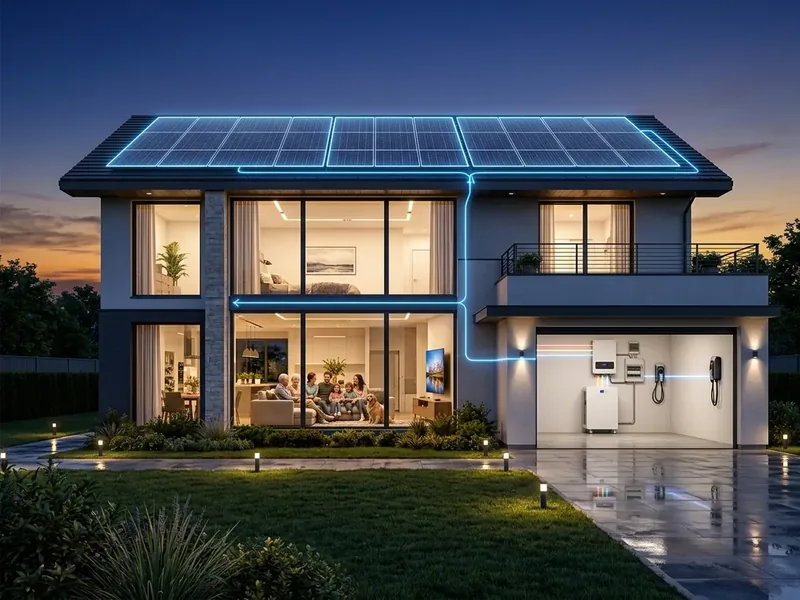
We will select and install a system that keeps your boiler, pump, fridge, internet and lighting running when the power goes out. We will explain in plain words what your home actually needs and what you can do without.
- We size the power for your appliances so you do not overpay for what you do not need
- Switches on automatically, runs silently and needs no fuel
- Turnkey: sizing, installation, setup and a walkthrough of how to use it
- You can start with a basic kit and add solar panels later
You do not need to be technical: an engineer will ask a few simple questions and suggest a solution.
[01] — Your situation
What needs to work in your home during a blackout?
Choose the option closest to your situation. An engineer will make the exact selection; this is just a starting point.
Not sure what to choose? — an engineer will call and ask you directly.
[02] — System selection
How to choose a system for your house
Six answers are enough for an engineer to propose a solution. If you don't know something, choose “Not sure” and we'll work it out together.
Answered 0 of 6 questions
Your answers help us understand your needs and choose the configuration. All questions are optional.
[03] — Ready-made solutions
Recommended configurations
The inverter (kW) determines how many appliances can run at the same time, the battery (kWh) determines for how long. The runtime on each card is a guide for an average load of 15–30 % of the smallest inverter power in the group and the largest capacity among the group’s ready-made kits, excluding conversion losses and depth of discharge. Click a card to open all matching kits with filters you can change or reset.
[05] — How we work
How it works
Request or call
You tell us what needs to keep working without mains power.
Call with an engineer
We clarify which appliances you have and ask for photos of your distribution board and the spot where the system will go.
Quote
We send you the system configuration and the price including installation, and let you know about availability and timelines. We explain what each component is for.
Installation
We install the system and connect it to your distribution board.
Commissioning and training
We configure the system, show you how to monitor it from your phone and leave you the documents.
[06] — Warranty and service
What you can expect
Manufacturer's warranty
The equipment is covered by the manufacturer's warranty. Terms and conditions are as stated in the documents for the specific model.
TermsWell-known manufacturers
We work with Deye, Fox ESS, Felicity Solar and Dyness equipment. Datasheets and certificates are on the product pages.
CatalogWhere we work
Installation and service: Kyiv and Kyiv Oblast. We ship equipment throughout Ukraine; in other cities installation is not guaranteed.
Contacts[07] — Questions
Honest answers
Will I overpay?
We size the system for your appliances rather than picking the most expensive one in the catalog, and we explain what each component is for. If your budget is limited, you can start with a basic system and expand it later.
What if there isn't enough power?
We add up the power of the appliances that run at the same time, allow a 20–30 % margin and separately check the inrush currents of pumps and compressors.
Is the system hard to use?
No. The system switches on automatically, so there is nothing to switch over. After commissioning, we will show you how to monitor the battery charge from your phone.
Is it safe to keep a battery at home?
The batteries have a built-in management and protection system (BMS). We install the equipment to the manufacturer's requirements: in a dry, ventilated room, on a solid base, with protective breakers in the distribution board.
Will it be noisy?
No. Unlike a generator, the system runs silently and needs no fuel.
What if something breaks?
The equipment is covered by the manufacturer's warranty; the terms and conditions are set out in the documents for the specific model. Call us and we will tell you what to do.
What power rating should I choose for a house?
Add up the power of the appliances that will run at the same time and allow a 20–30 % margin. For basic needs, 5–6 kW is enough; with a water heater and cooker, 8–10 kW; for a three-phase house, 12–15 kW.
How many hours can the house run on the battery?
A 5 kW + 10 kWh kit gives roughly 6–12 hours under a typical load. We will calculate the exact time for your appliances.
Can I do without solar panels?
Yes, the system works as backup power from the grid and the battery. Panels can be added later.
What should I buy for power outages?
To keep the boiler, pump, fridge and communications running, the most reliable option is a hybrid system: an inverter and battery, plus solar panels if you wish. It switches on automatically (the switchover time is in the model’s specifications), is quiet and needs no fuel.
[08] — Availability and timelines
Availability and timelines up front
If the model you need is out of stock, delivery can take up to 3 months. The installation schedule is currently booked about a month ahead.
- When we prepare the calculation, we will tell you what is in stock and what you will have to wait for.
- If you need it done by a certain date, mention it in your request and we will take it into account.
[→] — Request
Get a system recommendation for your home
Leave your phone number and an engineer will ask a few simple questions and prepare a quote with the price, availability and installation timeline.
- Phone+380 67 401 00 94
- Emailinfo@ienergy.com.ua
It is easiest to email photos of the distribution board and the boiler and pump rating plates.
Thank you! We have received your request.
What happens next:
- An engineer will contact you to clarify your appliances and details.
- They will ask for photos of your distribution board and the spot where the system will be installed.
- They will send you a quote with the price, availability and installation timeline.
While you wait, you can take photos of your distribution board and the rating plates on the boiler and pump; this will speed up the calculation.
Urgent question? +380 67 401 00 94