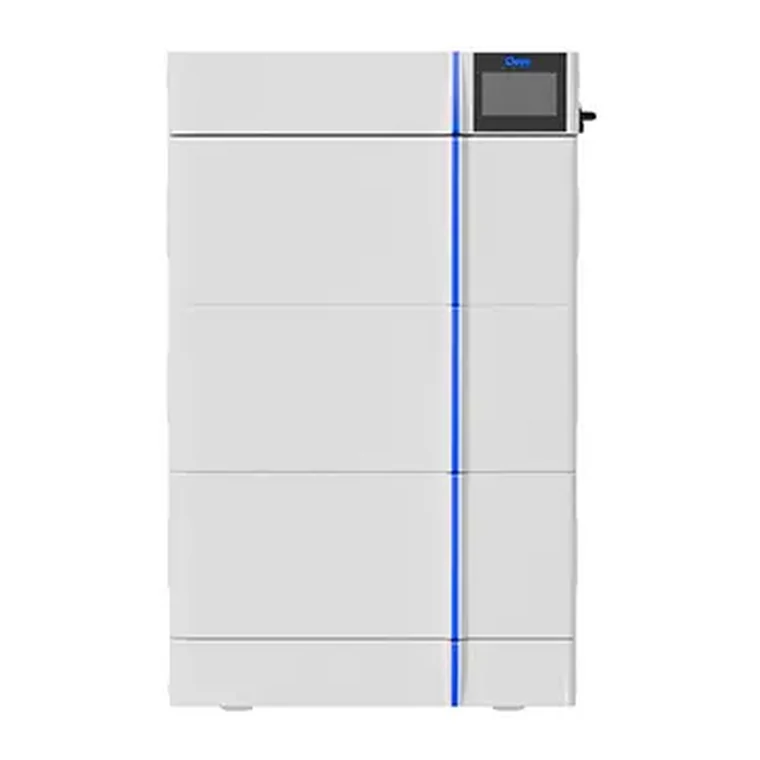
Add a Deye BOS-G high-voltage battery to the inverter: a cluster control box and BOS-GM5.1 modules in the quantity allowed by the manufacturer's compatibility list.
The rack, cables and protection must be confirmed by an engineer, so they are not included in the price.
This builds one cluster: an HVB750V/100A-EU control box and 4 to 12 BOS-GM5.1 modules per the Deye compatibility list. A second cluster is calculated by an engineer.
The power the battery can deliver to the inverter depends on the number of modules. An engineer will check that it is enough for your load.
Deye manufacturer data for the SUN-5~25K-SG01HP3-EU-AM2 series. A manager will confirm the string count, PV currents and battery charge current for this model before you order.
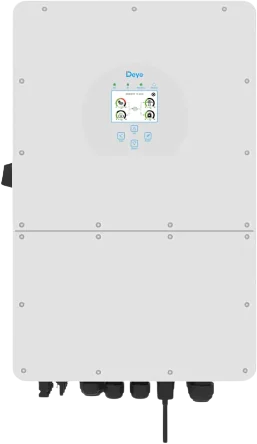
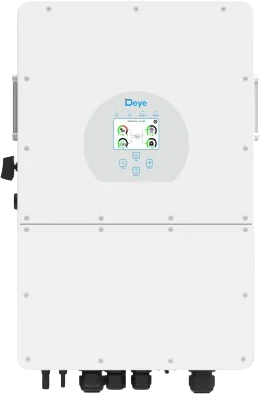
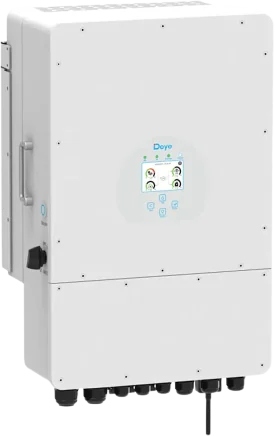
The 10 kW Deye SUN-10K-SG01HP3-EU-AM2 three-phase hybrid inverter works with the grid, solar panels and 160-700 V high-voltage batteries. It suits a home or small business with a three-phase supply that needs backup power and solar generation in one device.
It supports up to 20 kW of solar panels on 2 MPPT trackers. In off-grid mode it handles peak loads of 1.5× rated power for 10 s, and grid-to-load pass-through current is up to 80 A. IP 65 enclosure, operating temperature -40…+60 °C. Manufacturer warranty: 5 years, up to 10 years depending on the country of installation (Deye terms).
Features
Solar panels up to 20000 W
2 MPPT trackers
Battery voltage 160-700 V
IP 65 protection rating
Operating temperature -40…+60 °C, derating above 45 °C
Technical specifications
Battery type
Lithium-ion
Battery voltage range, V
160-700
Li-ion charging strategy
Automatic, based on BMS data
Number of battery inputs
1
Max. PV array power, W
20000
Max. PV input power, W
16000
Max. PV voltage, V
1000
Start-up voltage, V
180
MPPT voltage range, V
150-850
Number of MPPTs
2
Rated AC power
10000 W
Max. AC apparent power
11000 VA
Rated AC current, A
15.2/14.5
Max. AC current, A
16.7/16
Max. pass-through current (grid → load), A
80
Peak power (off-grid)
1.5× rated power, 10 s
Power factor
0.8 leading — 0.8 lagging
Rated AC voltage
220/380V,230/400V 0,85Un-1,1Un 3L+N+PE
Grid frequency, Hz
50/45-55, 60/55-65
Harmonic distortion THDi
<3% (of rated power)
DC current injection
<0,5%ln
Max. efficiency
97,6%
European efficiency
97,0%
MPPT efficiency
>99%
Built-in protection
DC reverse polarity protection, AC overload protection, thermal protection, AC overvoltage protection, AC output short-circuit protection, DC injection monitoring, AFCI (optional), anti-islanding protection, DC switch, insulation resistance monitoring, leakage current monitoring
Surge protection
TYPE II(DC),TYPE II(AC)
Display
LCD
Communication interfaces
WiFi, RS485, CAN
Monitoring
GPRS/WIFI/Bluetooth/4G
Operating temperature
-40…+60 °C, derating above 45 °C
Permissible humidity
0-100%
Permissible altitude, m
2000
Noise level, dB
≤ 55
Ingress protection
IP 65
Topology
Transformerless
Overvoltage category
OVC II(DC),OVC III(AC)
Dimensions (W×H×D), mm
408×638×237
Weight, kg
30,5
Cooling
Smart air cooling
Warranty
5 years, up to 10 years depending on the country of installation (Deye terms)
Grid standards
IEC 61727, IEC 62116, CEI 0-21, EN 50549, NRS 097, RD 140, UNE 217002, OVE-Richtlinie R25, G99, VDE-AR-N 4105
Which batteries are compatible with this inverter?
High-voltage lithium batteries with an operating voltage within 160–700 V from the Deye compatibility list, such as Deye GB-L Pro or BOS-G. We will match the number of modules and BMS settings to your needs.
Can solar panels be connected later?
Yes. The inverter can run with just the grid and a battery, and up to 20 kW of panels on 2 MPPTs can be added later.
How many hours will the system run during a power outage?
It depends on battery capacity and load. Use the autonomy calculator or send a request and we will calculate it.
What is included in the price?
The price is for the equipment, excl. VAT. Cables, switchgear, protection, installation and setup are calculated after a site visit or from a photo of the distribution board.
[→] — Request
Tell us about your property
We will select the configuration, check compatibility and calculate the cost with installation.
Photos of the distribution board, a list of appliances or a roof plan are easier to send by e-mail. Planning an installation? Fill in the technical brief — for a home or a business.