How long will it run Deye 8 кВт + SE-F16-C 16 кВт·год?
Required capacity = load × time ÷ 0.855: we use 90 % of capacity as a reserve and 95 % conversion efficiency. Battery-side power = battery voltage × the inverter's battery-input current (manufacturer data). This is a guide, not a guarantee: inrush currents, temperature and settings are not included.
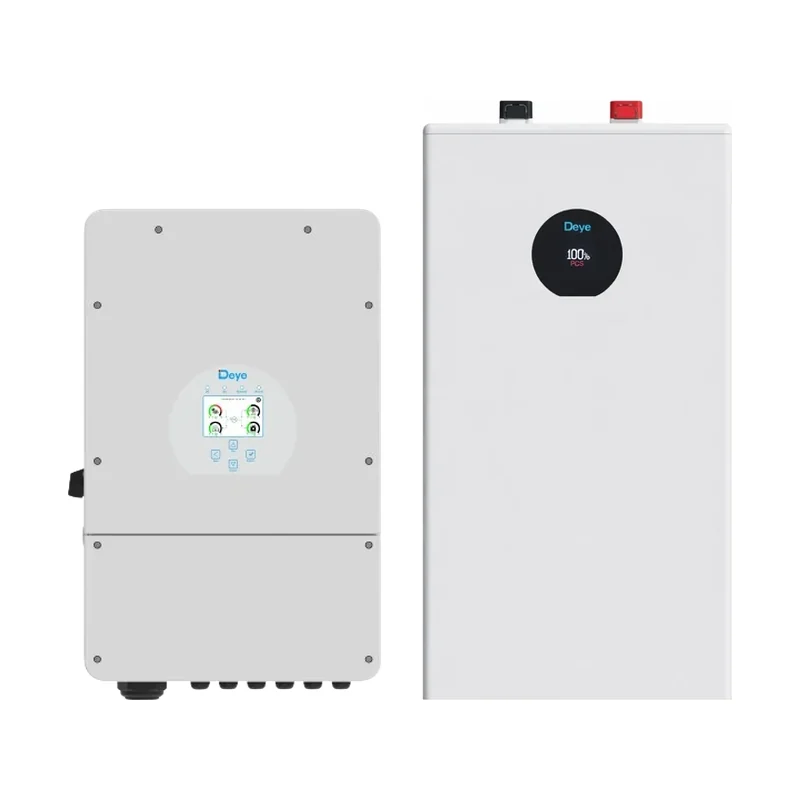
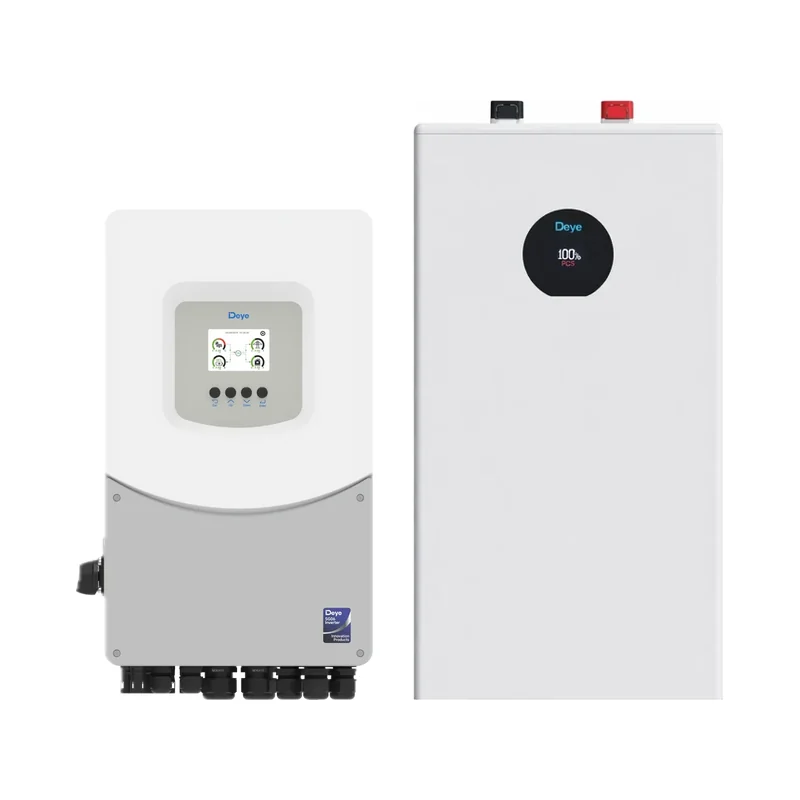
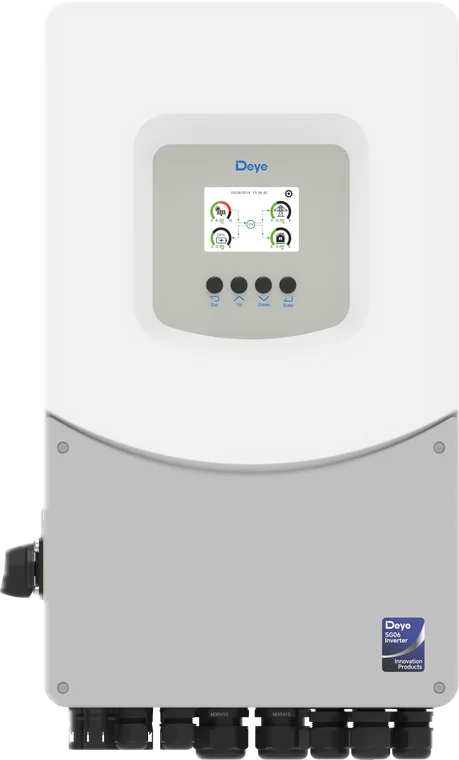
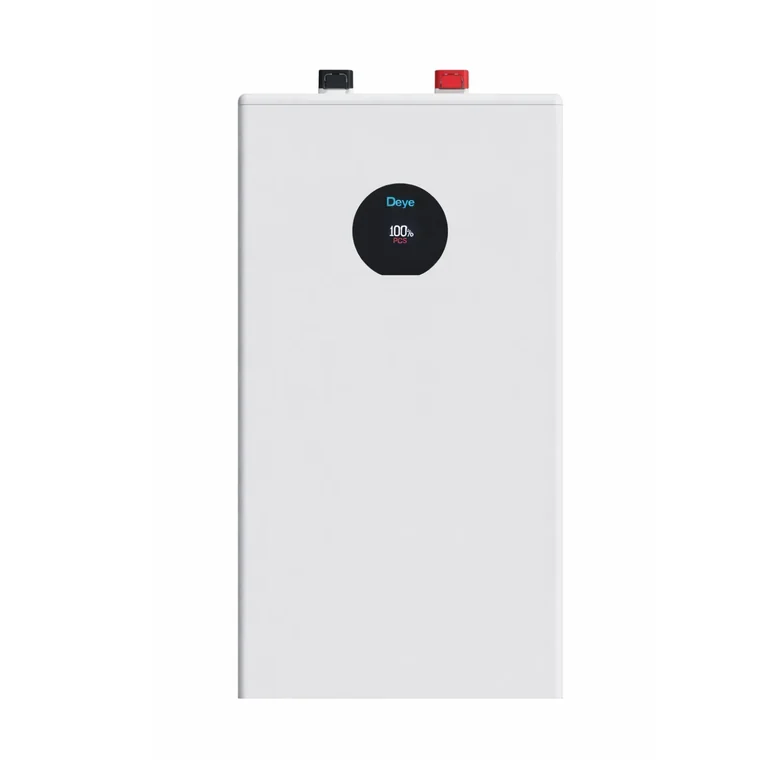
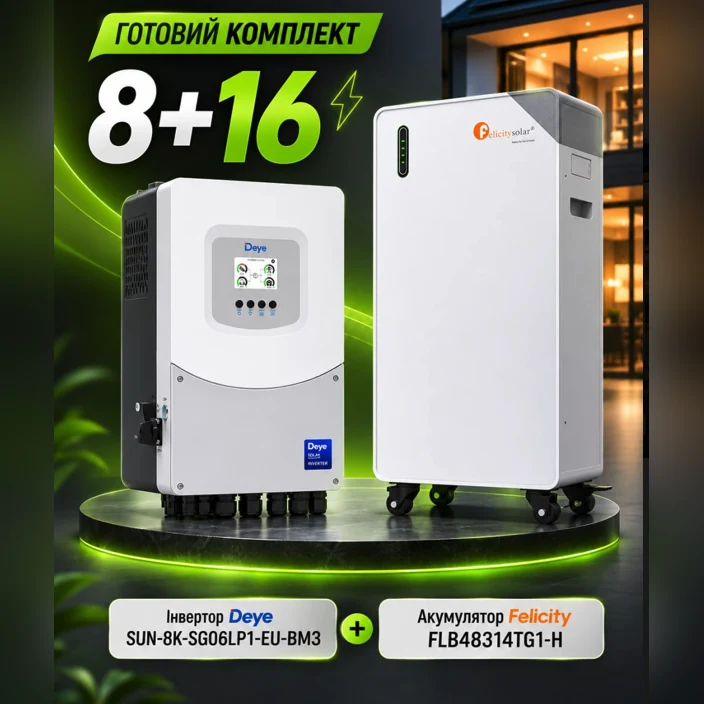
A single-phase Deye kit for an apartment or a house: an 8 kW SUN-8K-SG06LP1-EU-BM3 hybrid inverter and a 16 kWh SE-F16-C low-voltage LiFePO₄ battery. Both come from the same manufacturer, so the inverter and battery work together without extra adapters.
The inverter draws energy from the grid, the battery and solar panels (3 MPPTs, up to 16 kW of panels), charges and discharges the battery at up to 185 A, so the full 8 kW can be drawn from the battery, and off-grid handles double its rated power for 10 seconds, e.g. when a pump starts. The battery delivers up to 230 A continuously, is rated for at least 6000 cycles, and capacity can be expanded to 32 modules in parallel.
Features
8 kW inverter, 1 phase
3 MPPTs, up to 16 kW of solar panels
Peak power 2× rated (10 s)
16 kWh LiFePO₄ battery, 314 Ah
6000+ cycles, up to 32 batteries in parallel
Technical specifications
Inverter
Deye SUN-8K-SG06LP1-EU-BM3
Rated inverter power
8 kW
Max. AC apparent power
8.8 kVA
Phases
1 (220/230 V)
Inverter type
Hybrid, low-voltage
MPPTs / strings
3 / 2+1+1
Max. PV array power
16 kW
Max. PV voltage
500 V
MPPT range
150–425 V
Battery voltage
40–60 V
Max. inverter charge/discharge current
185 A
Max. pass-through current (grid → load)
65 A
Peak power (off-grid)
2× rated, 10 s
Max. inverter efficiency
97.6 %
Inverter protection rating
IP65
Inverter dimensions
340 × 580 × 227 mm
Inverter weight
23.7 kg
Battery
Deye SE-F16-C
Battery type
LiFePO₄
Battery capacity
16 kWh
Nominal voltage
51.2 V
Cell capacity
314 Ah
Battery charge / discharge current (continuous)
160 A / 230 A
Recommended depth of discharge
90 %
Cycle life
≥6000 cycles (25 °C, to 70 % capacity)
Scalability
up to 32 batteries in parallel
Battery protection rating
IP21
Battery dimensions
400 × 708 × 233 mm
Battery weight
109 kg
Communication
Wi-Fi, RS485, CAN; battery — Bluetooth, app
Deye manufacturer data. Confirm the configuration before ordering.
Installation space
How much space the kit needs: the layout we use on our sites, clearances per the manufacturer’s manual. Approximate figures; the exact layout is agreed during the site visit.
Battery on the floor, the inverter’s small breaker box above it, inverter on the wall above. Dashed areas are the manufacturer’s clearances.
Layout
battery on the floor, the inverter’s small breaker box above it, inverter on the wall above
Width
≈ 0.40 m (battery ≈ 0.40 m, inverter ≈ 0.34 m); with the side clearances of the inverter ≈ 1.34 m
Equipment height
≈ 1.79 m
Free wall height
≈ 2.29 m
Depth from the wall
≈ 0.23 m + 1 m free access in front
Floor area for batteries
≈ 0.40 × 0.23 m
Total equipment weight
≈ 133 kg (batteries ≈ 109 kg)
How the width is calculated
widest item — battery 400 mm; inverter 340 + 2 × 500 at the sides = 1 340 mm
How the height is calculated
battery 708 + breaker zone 500 (box 200 + 50 to battery and inverter; not less than the inverter’s bottom clearance 500) + inverter 580 = 1 788 mm; + 500 free above the inverter = 2 288 mm
Clearances around the inverter: Deye manual: approx. 50 cm to the sides, above and below, 1 m in front. The size of the inverter’s breaker box (height 200 mm; a small box between inverter and battery, not the main panel), 50 mm from it to the battery and the inverter and 100 mm between battery columns are our assumptions for a typical installation, not manufacturer data. Equipment sizes and weights are from the manufacturers’ datasheets. Cable trays, room ventilation and floor load for heavy batteries are checked during the site visit.
A Deye SUN-8K-SG06LP1-EU-BM3 hybrid inverter and a Deye SE-F16-C battery. We select cables, switchgear and protection to suit your distribution board.
How does this kit differ from the Deye 10 kW + SE-F16-C?
The battery is the same 16 kWh SE-F16-C. The 8 kW inverter has 2 kW less rated power, accepts up to 16 kW of solar panels (the 10 kW model takes up to 20 kW) and has a more compact housing — 340 × 580 mm.
How many hours will the kit run during a blackout?
It depends on the average load and system settings. Use the autonomy calculator or send a request and we'll calculate it for your list of appliances.
Can solar panels be added?
Yes. The inverter has 3 MPPT trackers and accepts up to 16 kW of panels at PV voltage up to 500 V.
What is included in the price?
The price is for the equipment, excl. VAT, and equals the sum of the inverter and battery prices on the site. Cables, switchgear, protection, installation and setup are calculated after a site visit or from a photo of the distribution board.
[→] — Request
Tell us about your property
We will select the configuration, check compatibility and calculate the cost with installation.
Photos of the distribution board, a list of appliances or a roof plan are easier to send by e-mail. Planning an installation? Fill in the technical brief — for a home or a business.